
If you have been wondering what is GEO vs SEO vs AEO, you are not alone. Search has shifted from a single channel into a landscape of traditional results, AI-generated answers, and voice interfaces, and each one requires a different approach to content and visibility.
This guide explains what each discipline means, how they differ, where they overlap, and what Australian businesses should do about all three right now. Whether you are building a strategy from scratch or refining an existing one, understanding GEO, SEO, and AEO is now essential. Our digital marketing agency works with Australian businesses across all three, and this is how we think about them.
Key Takeaways
- SEO optimises for traditional search engine rankings. It remains the foundation of digital visibility.
- GEO optimises for AI-generated answers in tools like Google AI Overviews, ChatGPT, and Perplexity.
- AEO optimises for direct answers in voice assistants and zero-click search results.
- All three share the same foundation: authoritative, well-structured, genuinely useful content.
- Businesses that invest in SEO now are already building the foundation for GEO and AEO visibility.
What Is GEO vs SEO vs AEO? The Short Answer
The clearest way to understand GEO vs SEO vs AEO is to look at what each one is optimising for. Here is the one-line version of each:
| Discipline | Full Name | What It Optimises For |
| SEO | Search Engine Optimisation | Rankings in Google and Bing search results |
| GEO | Generative Engine Optimisation | Citations in AI-generated answers (Google AI Overviews, ChatGPT, Perplexity) |
| AEO | Answer Engine Optimisation | Direct answers in voice search, featured snippets, and zero-click results |
All three disciplines are about search visibility, but they target different surfaces and respond to different signals. The good news is that strong, well-structured content works across all three.
What Is SEO and Why It Still Comes First
Search engine optimisation is the practice of improving a website’s visibility in organic search results. It has been the cornerstone of digital marketing for over two decades. Despite the rise of AI search, it remains the highest-volume channel for most Australian businesses.
SEO works across three layers: technical, on-page, and off-page. Technical SEO makes your site fast, crawlable, and structurally sound. On-page SEO optimises content, headings, and metadata for target keywords. Off-page SEO builds authority through backlinks and brand signals. All three layers matter, and neglecting any one of them limits the impact of the others.
Why SEO Is Still the Highest-Return Channel
Organic search drives more traffic than any other digital channel for most businesses. Unlike paid media, the traffic it generates does not stop the moment you stop spending. A well-optimised article, guide, or service page can drive qualified visitors for years.
Our SEO services are built around this compounding principle: invest in content and structure that keeps paying back over time.
What SEO Looks Like in Practice
- Content creation that answers search intent better than competing pages
- Keyword research to identify what your audience is searching for
- On-page optimisation of titles, headings, meta descriptions, and content structure
- Technical audits to fix crawl errors, improve page speed, and ensure mobile performance
- Link building to grow domain authority and search rankings
What Is GEO and Why It Matters for AI Search
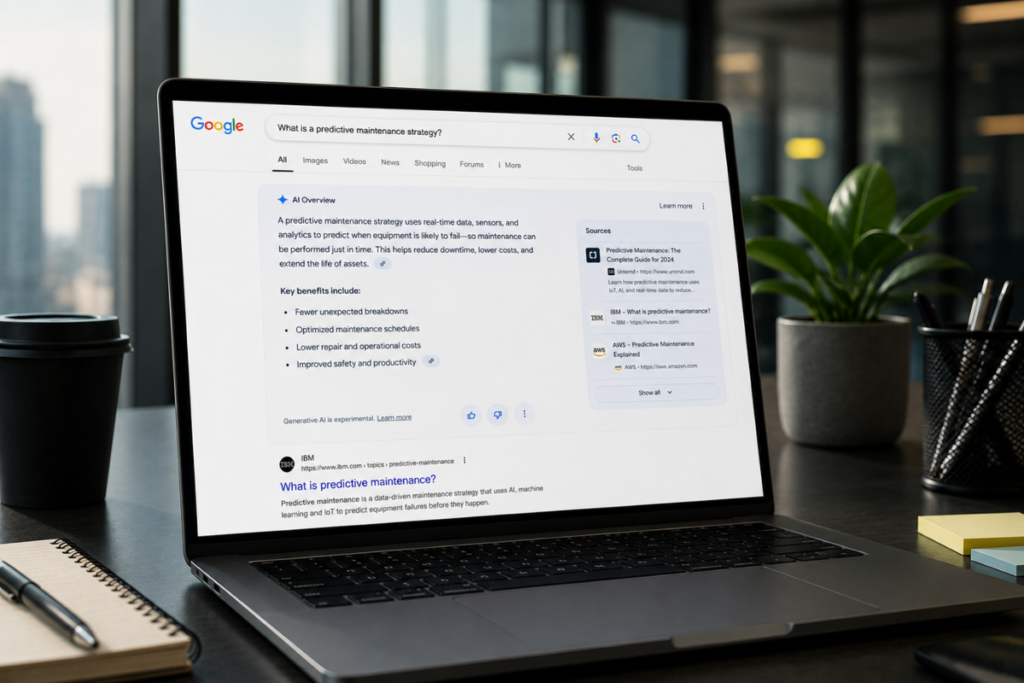
Generative Engine Optimisation, or GEO, is the practice of structuring your content so that AI-powered search engines cite and surface your brand in their generated answers. GEO’s meaning in marketing is simple: it is the discipline of earning visibility in AI-generated results rather than traditional ranked lists. When someone searches in Google AI Overviews, ChatGPT Search, or Perplexity and an AI synthesises a response, GEO determines whether your content is part of that response.
In SEO terms, GEO is a parallel discipline, not a replacement. GEO is newer than SEO and the research is still developing, but the direction is clear. AI search is growing rapidly, and brands without strong content foundations are invisible in it. The businesses investing in quality, well-structured content now are building a compounding GEO advantage over the next two to three years.
How GEO Differs From SEO
SEO optimises for ranking positions in a list of results. GEO optimises for citation within a synthesised answer. In a traditional search, the user sees ten blue links and chooses one. In an AI-generated result, the AI constructs an answer and may cite two or three sources. Getting into that citation pool requires a different kind of content authority.
GEO digital marketing favours content that is comprehensive, clearly structured, factually accurate, and written with genuine expertise. Short, thin content rarely earns AI citations. Depth and specificity are what AI engines look for when building trustworthy answers.
What GEO Looks Like in Practice
- Publishing in-depth guides and articles that answer questions thoroughly
- Using clear H2 and H3 headings that signal topic structure to AI engines
- Including FAQ sections with direct, well-formed question-and-answer pairs
- Building topical authority by covering a subject comprehensively across multiple pieces
- Earning backlinks and brand mentions from credible sources
- Applying structured data markup (schema) so AI engines can parse your content accurately
This is closely aligned with how we approach content marketing at UNTMD. Every piece of content we produce is built to earn visibility across both traditional search and AI-generated answers.
What Is AEO and How It Differs From SEO and GEO
Answer Engine Optimisation, or AEO, is the practice of structuring your content to appear in direct answer formats: featured snippets, voice search responses, Google’s People Also Ask boxes, and zero-click results. AEO is less about ranking in a list and more about being the definitive answer to a specific question.
AEO, SEO, and GEO share the same content foundation, which is why investing in one tends to lift all three. Treating them as a connected system rather than separate strategies is the most practical approach.
AEO has become increasingly important as voice search has grown and as Google has expanded featured snippets. If you have ever asked a voice assistant a question and received a specific spoken answer, that answer came from a page optimised for AEO.
How AEO Differs From GEO
GEO targets AI synthesis engines that construct their own written answers. AEO targets systems that pull an existing passage from a web page and present it directly. Both reward clear, structured, well-written content. The difference is in how that content is consumed: GEO earns citation in a generated response, AEO earns extraction as a direct answer.
What AEO Looks Like in Practice
- Writing concise, direct answers to specific questions within body copy
- Structuring FAQ sections with clean question headings followed by short, complete answers
- Using structured data markup including FAQPage, HowTo, and Speakable schema
- Targeting question-based keywords: who, what, when, where, why, and how queries
- Keeping answer paragraphs to two or three sentences so they can be easily extracted
- Matching the exact language your audience uses when asking questions aloud
GEO vs SEO vs AEO: Side-by-Side Comparison

| SEO | GEO | AEO | |
| What it targets | Google and Bing organic rankings | AI-generated answers and citations | Featured snippets and voice answers |
| Primary channel | Search engine results pages | AI Overviews, ChatGPT, Perplexity | Voice search, PAA boxes, snippets |
| Content type | Keyword-optimised pages and articles | In-depth authoritative content | Short, direct question-and-answer content |
| Key signal | Backlinks and on-page relevance | Depth, accuracy, and topical authority | Structure, clarity, and schema markup |
| Time to results | 3 to 12 months | 6 to 18 months | Weeks to months |
| Difficulty (2026) | Moderate to high | Low to moderate (early) | Low to moderate |
The most important takeaway from this comparison is that all three disciplines reward the same behaviour. Useful, well-structured content and domain authority built consistently over time are the foundation of visibility across SEO, GEO, and AEO.
Which One Should Your Business Prioritise?
Once you understand the difference between GEO, SEO, and AEO, the natural next question is where to start. For most Australian businesses in 2026, the answer is to begin with SEO and build GEO and AEO into the same content system. They are not competing strategies. They are layers of the same approach, each reinforcing the others.
Start With SEO If:
- You have limited organic visibility and need to build traffic from the ground up
- You are in a competitive market where ranking in traditional search is the primary lever
- You have not yet built a content library or established domain authority
- Your audience is still primarily using traditional Google search to find your services
Prioritise GEO If:
- You already have strong SEO foundations and want to extend visibility into AI search
- Your audience is beginning to use AI tools for discovery and research in your category
- You produce long-form content and want it cited in AI-generated answers
- You are in a space where being the cited authority carries significant brand value
Focus on AEO If:
- Voice search is relevant to your audience (local businesses, frequently asked questions)
- You want to capture featured snippet positions for high-intent question keywords
- Your content strategy includes a substantial FAQ component
- You have existing content that could be restructured to earn direct answer placements
The Practical Reality for Most Businesses
The cleanest strategy is to build SEO-optimised content with GEO and AEO principles baked in from the start. Structure every piece with clear headings. Answer questions directly. Build topical depth. Apply schema markup. This single approach serves all three disciplines without requiring three separate content programmes. Our full service marketing agency approach connects SEO, content, and AI search strategy into one coordinated plan.
How To Build Content That Works for SEO, GEO, and AEO at Once

The most efficient approach is to plan your content with all three disciplines in mind from the start, rather than retrofitting each one separately. Here is what that looks like in practice.
1. Start With Keyword and Question Research
Identify the keywords your audience searches in Google (SEO), the questions they ask AI tools (GEO), and the conversational queries they might use by voice (AEO). There is significant overlap. A well-chosen topic often has value across all three surfaces.
2. Structure Content Around Clear Questions and Answers
Use H2 and H3 headings that reflect the questions your audience is asking. Follow each heading with a clear, direct answer before expanding into detail. This structure works for traditional SEO, signals topic relevance to AI engines for GEO, and makes content easy to extract for AEO.
3. Build Topical Depth, Not Just Coverage
A single shallow article rarely earns strong visibility in SEO, GEO, or AEO. Content for AI search needs to demonstrate topical depth, not just cover a subject once. A cluster of connected, in-depth articles on a subject builds topical authority. AI engines in particular look for brands that cover a topic comprehensively and consistently, not just brands that have published one relevant page.
4. Apply Schema Markup Consistently
Schema markup helps all three disciplines. FAQPage schema supports AEO by structuring question-and-answer pairs for extraction. Article schema supports GEO by telling AI engines what your content is about and who produced it. Organisation and LocalBusiness schema build the brand entity signals that underpin all search visibility.
5. Earn Authority Through Backlinks and Brand Mentions
Both SEO and GEO reward domain authority. Backlinks from credible sources tell search engines and AI engines that your content is trustworthy. Brand mentions, media coverage, and PR activity all feed the same signal. Our public relations agency work is designed to build exactly this kind of authority, which supports visibility across SEO, GEO, and AEO simultaneously.
The question of what is GEO vs SEO vs AEO will keep coming up as search continues to evolve. The businesses that build authority now, while AI search visibility is still relatively uncrowded, will have a compounding advantage over those that wait.
If you are not sure where to start, the answer is simple: SEO first, then layer GEO and AEO on top.
Our team works with businesses across Melbourne, Sydney, Brisbane, and across Australia to build content and search strategies that compound across all three disciplines. Book a strategy session to see what that looks like for your business.
Frequently Asked Questions About What Is GEO vs SEO vs AEO
No. GEO is an additional layer of search visibility, not a replacement for SEO. Traditional organic search still drives the majority of search traffic for most businesses. GEO extends that visibility into AI-generated answers. Both matter, and they share the same content foundation.
Not necessarily. The most efficient approach is to build SEO-optimised content with GEO and AEO principles built in from the start. Clear headings, direct question-and-answer sections, schema markup, and topical depth serve all three disciplines without requiring separate content programmes.
GEO results typically appear within six to eighteen months of consistent, high-quality content production. AI engines prioritise content from authoritative domains, so building domain authority through SEO first accelerates GEO visibility. Early movers in GEO have a meaningful advantage right now because competition is still low.
Featured snippets are one output of AEO. Answer engine optimisation is the broader practice of structuring content to appear in any direct-answer format: featured snippets, People Also Ask boxes, voice search responses, and zero-click results. Winning a featured snippet is a sign that your AEO approach is working.
Yes. Schema markup helps AI engines and answer engines understand the structure, authorship, and purpose of your content. FAQPage schema is particularly effective for AEO. Article and Organisation schema build the entity signals that support GEO. It is one of the most cost-effective technical improvements any business can make to its content.